
achievements
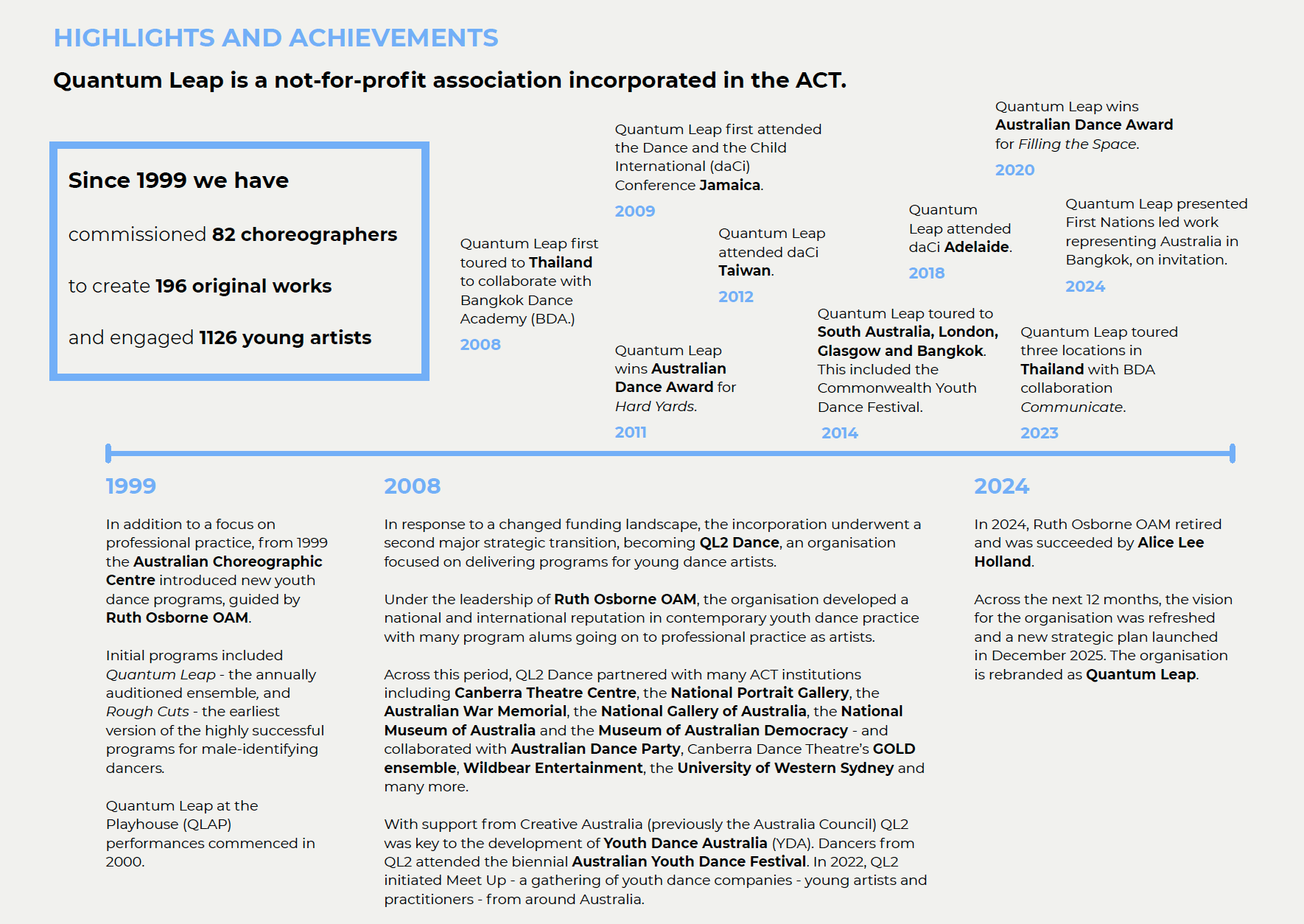
We are a unique organisation in Australia. We deliver quality programs and produce exceptional performances and outstanding opportunities for young people every year. Over the years we have commissioned over 60 choreographers to work with us on our projects providing employment and unique opportunities to emerging and established dance artists.
We have evolved and grown over the past 20+ years with Alumni now making their mark around the world excelling as independent artists, following their chosen paths in national and international dance companies, working as teachers and education officers for major dance companies and extending into cross-art forms. Many have returned to QL2 for commissions and residencies.
Artistic Director Ruth Osborne received a Churchill Fellowship to research youth dance practice across the UK in 2017. She received an Australian Dance Award for Service to Dance in 2012 and short listed for an Australian of the Year Award in 2018. QL2 has been a finalist for several years for an Australian Dance Awards for its Quantum Leap Productions.
QL2 was commissioned for the Austrade Export Awards 2018 and has received several commissions from the National Portrait Gallery of Australia in recent years. QL2 has an ongoing relationship with the National Gallery of Australia collaborating recently with them for their American Masters - Merce Cunningham exhibition 2018.
We offer opportunities nationally through our Curated Residency Program and our participation in the Australian Youth Dance Festival. Through financial support from the Tanja Liedtke Foundation we have hosted the Tanja Liedtke Workshop for the last 5 years consistently over the 20 years we have helped our Quantum Leapers to enter the various tertiary institutions and we maintain strong connections to these institutions and to youth dance companies across Australia.
We continue to develop and maintain our international relationships through DaCi (Dance and the Child International) where we have performed and presented papers, our connections with YDance (Youth Dance Scotland) and the National Youth Dance Company of Scotland who we hosted in 2016, as well as a long association with Bangkok Dance Academy and our many alumni overseas.
Before we were QL2 Dance
From 1980–1996, a succession of professional local dance companies were based in Canberra at Gorman Arts Centre.
QL2 Dance has its origins, in part, in this line of companies: it is the same Incorporated Association through many name changes, but with very different goals, responding to changing times.
1980–1996: ORIGINS
Founded in 1980 by Don Asker as Human Veins Dance Theatre, the organisation later established an international reputation as the Meryl Tankard Company from 1989. In 1992 Sue Healey was appointed, with the organisation becoming Vis-a-Vis Dance Canberra; producing excellent work in Canberra and elsewhere.
1996: a ‘Choreographic Centre’
In 1995, the Board decided that there was insufficient financial and audience support for a permanent dance company in Canberra.The Board then conducted an exhaustive process of consultation, including both local and national dance and arts communities, to determine a way forward. This identified a need for a new approach to choreographic development. The organisation launched operations as ‘The Choreographic Centre’ in late 1996 under the leadership of Artistic Director Mark Gordon, later changing name to The Australian Choreographic Centre.

Mark Gordon and Ruth Osborne 2002
This was partly a response to a more global crisis in professional contemporary dance, its audiences and funding, which accompanied the global financial recession from 1987. Choreographers and dancers faced a crisis in career pathways, with many small dance companies closing, annual employment in most existing companies being replaced by run-of-project contracts, and the number of independent projects being significantly reduced. The environments where choreographers had traditionally been nurtured and developed almost vanished, seriously threatening the growth of the next generation of dance makers. We sought to fill this niche, both for the ACT community and for the profession.
We evaluated some overseas developments, in particular a French system, where the government took on board the success of “actor centres” which solved similar problems for the theatre community a decade before. “Centres Chorégraphique National” were developed, providing infrastructure for a key choreographer while also supporting a number of emerging choreographers and assisting visiting artists in creating, presenting and touring new work.
The Choreographic Centre was established in Canberra with much of this in mind, but was designed to be a more inclusive and open structure where individuality was supported and encouraged and the artistic vision embraced a wide range of styles and traditions. It was for 11 years a leader in supporting the development of the art, craft and science of choreography — enhancing the contribution which dance makes to cultural life. Through a nationally competitive program of fellowships, residencies and commissions plus educational, advocacy and scientific research activities, it became a centre for the development of choreographers, choreographic practice, and new choreographic works; led by visionary Artistic Director Mark Gordon.
Over the life of The Australian Choreographic Centre, our major goals and strategies proved to be important for the dance profession. We contributed to the development of over 70 choreographers, some of who have gone on to become artists of renown. We actively developed partnerships for three 3-year academic research projects into the nature of choreographic cognition, funded by the Australian Research Council. We nurtured the creation of over 260 dance works, ranging from 5-minute experimental sections, to complete 90-minute works. Our youth dance program — headed by Ruth Osborne — was a model of best practice for Australia. We developed our commissions program to provide multiple entry points at different levels of skill and experience.
2007: QL2 Dance
In 2007, following changes in the funding landscape, the Board of the Centre took the decision to re-focus the organisation as QL2 Centre for Youth Dance Inc, later simplifying the name to QL2 Dance Inc. With Artistic Director Ruth Osborne at the helm, it has since developed a national and international reputation in contemporary youth dance practice; and many alumni are practicing dance artists.
A note on the names QL2 Dance and Quantum Leap
QL2 is not an acronym or abbreviation.
Quantum Leap is a current program of QL2 Dance. This program first began at The Choreographic Centre as Quantum Leap Youth Choreographic Ensemble.
QL2 Dance’s Quantum Leap ensemble is an ensemble of dancers, aged 14 to 26 years. It is auditioned each year and open to dancers in our training programs and those training in physical disciplines elsewhere.